Teaching

Teaching Statement
Philosophy of Teaching
Educating the mind without educating the heart is no education at all, said by Aristotle. The greatest enemy of knowledge is not ignorance, but illusion of knowledge, said by Stephen Hawk. One important task of teaching is to facilitate learners to master complex knowledge and skills in science and engineering. Hence, the primary role of professors should be the facilitator of making knowledge and skills easily accessible to learners of different capabilities. As shown in the Figure below, I concur that a good educational system should include a) video-based self-learning, b) classroom-based interaction learning, and c) experiment-based live learning. In fact, all my teaching materials do include a) recorded videos of lectures/tutorials, b) slides for classroom lectures/tutorials, and c) hand-on sessions for learnt knowledge.
In order to help students to adjust their mindsets to match with any specific course, I always remind students to position themselves into one of the following two roles, which are: a) to become future designers of products or systems in which the knowledge and skills will be covered by a course to be learnt, or b) to become future users of products or systems in which the knowledge and skills will be covered by a course to be learnt. In general, the learning objective of any course should be a weighted sum of both roles.
Portfolio of Teaching
My contributions toward teaching include
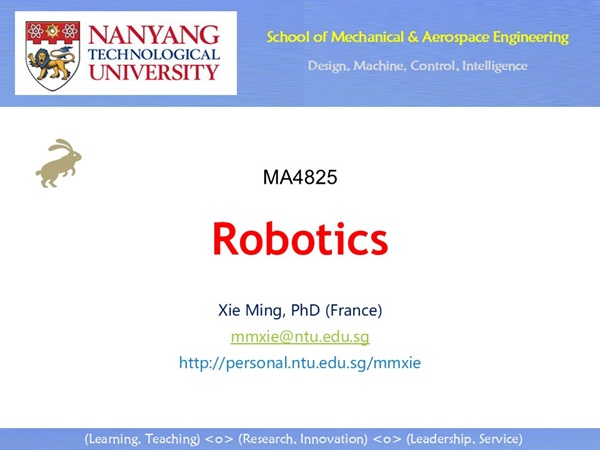
- Design, refinement and lecture of “MA4825 Robotics” course as course coordinator.
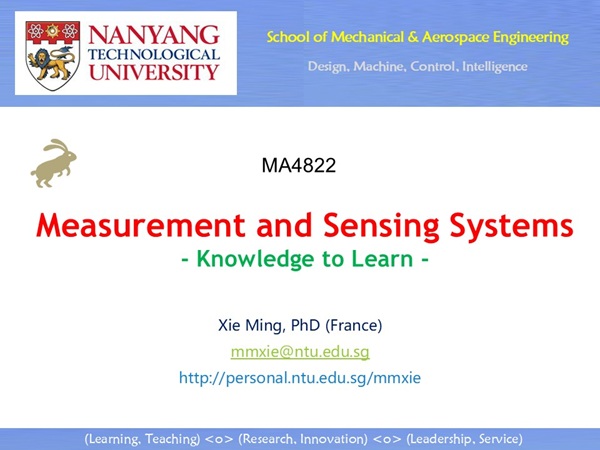
- Design, refinement and lecture of “MA4822 Measurement and Sensing Systems” course as course coordinator.
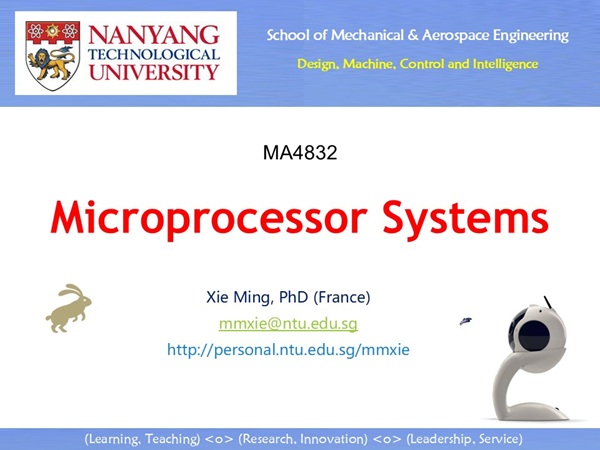
- Design, refinement and lecture of “MA4832 Microprocessor Systems” course as course coordinator.
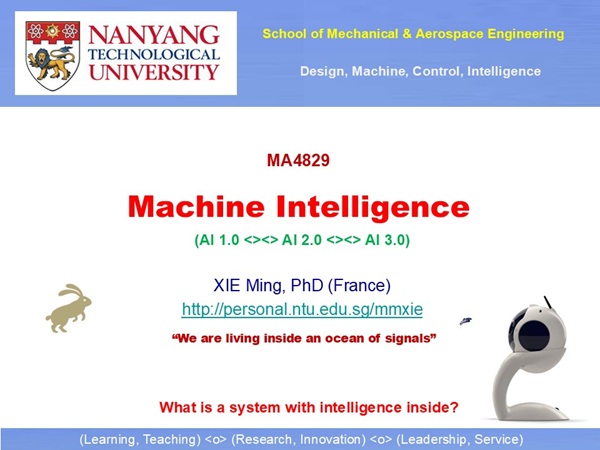
- Design, refinement and lecture of “MA4829 Machine Intelligence” course as course coordinator (subsequently the role has been transferred to another faculty member due to my heady works).
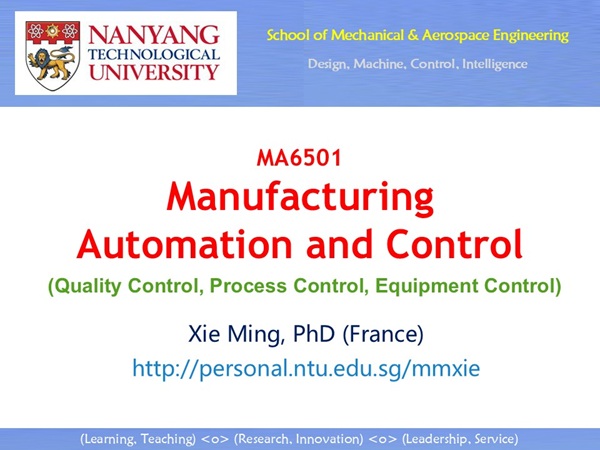
In parallel, I also contribute to the teaching of “MA3005 Control Theory” course and the lecture of “MA6501 Manufacturing Automation and Control” course.
In addition, I have regularly conducted short courses for external learners. These short courses include:
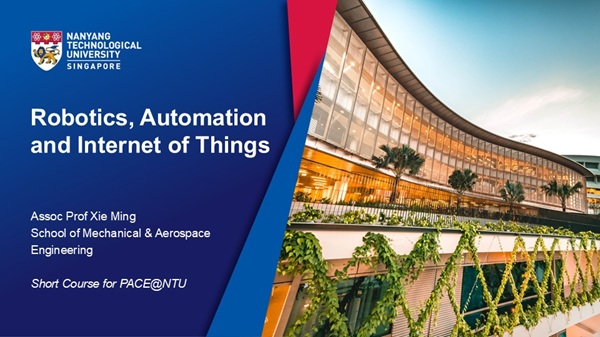
- PACE@NTU Course on Robotics, Automation and Internet of Things
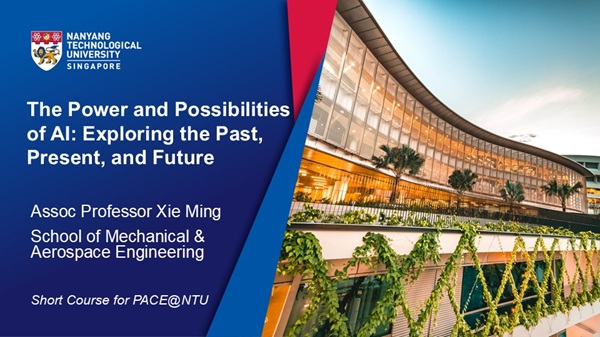
- PACE@NTU Course on the Power and Possibilities of Artificial Intelligence.
<><><><><>
MA4822 Measurement and Sensing Systems
The aim of this course is to educate the students with the basic science of measurements, as well as the principles behind the design of various types of sensors. The scope of this course covers sensors in mechanical systems, electrical systems, fluid systems, environmental systems, and perception systems. At the end of the study of this course, the students should be able to understand the principles of sensing systems, and the principles of measurement systems. In addition, the students will be able to select appropriate sensors, and to incorporate these sensors into the design of smart products and systems. In particular, the students should be able to apply learnt knowledge to guide the design of various sensors which could be used in sciences, engineering projects and industries.
(Module 1, Module 2, Module 3, Module 4, Module 5)
<><><><><>
MA4825 Robotics
The aim of this course is to educate students with the fundamental knowledge and basic skills in robotics, which will enable them to become future designers of robots as well as future researchers in robotics. This robotics course will cover the following key topics such as: Mechatronic Design of Robots, Robot Perception, Robot Motion Planning, Robot Motion Control, Robot Kinematics, and Robot Dynamics. At the end of the study of this course, the students should be able to understand a) the design principles of robot’s body, mind and brain, b) the principles and solutions behind robot’s visual perception, c) the principles and solutions behind robot’s motion planning, d) the principles and solutions behind robot’s motion control. Also, the students should be able to apply learnt knowledge to venture into the design of robots as products, or to use robots as automated machines in industries and societies.
(Module 1, Module 2, Module 3, Module 4)
<><><><><>
MA4829 Machine Intelligence
The scope of this course covers machine thinking (AI 1.0), machine learning (AI 2.0) and machine’s self-intelligence (AI 3.0). Unprecedently, this is the unique course in the world which provides the most comprehensive coverage of the science of mind under the context of taking visual signals as the input to AI systems or AI products. From this course, the students will learn the basic working principles underlying the transformations such as a) transformation from visual signals to knowledge, b) transformation from existing knowledge to new knowledge, c) and transformation from knowledge to control signals. At the end of the study of this course, the students should be able to develop AI products and AI systems for society as well as autonomous machines for manufacturing.
(Module 1, Module 2, Module 3, Module 4, Module 5)
<><><><><>
MA4832 Microprocessor Systems
Microcontrollers are the basic building blocks inside all the automation systems as well as data communication networks in industry and society. Without microcontrollers, there will be no intelligent manufacturing, no internet of things, and no smart cities. A microcontroller is a microprocessor system, which includes central processing unit, input interface modules, and output interface modules. The aim of this course is to educate students with the basic knowledge and programming skills of ARM Cortex M4 microcontroller, which will enable them to become future users of microcontrollers. This course will cover the topics such as: knowledge and skills related to programming the central processing unit of microcontroller, knowledge and skills related to programming input interface modules of microcontrollers, as well as knowledge and skills related to programming output interface modules of microcontrollers. At the end of the study of this course, the students should be able to apply learnt knowledge and skills to implement networked smart sensors, networked smart actuators, networked haptic devices, and a large variety of control systems and robot systems in industry and society.
(Session 1, Session 2, Session 3, Session 4, Session 5, Session 6)
<><><><><>
<><><><><>
<><><><><>