Service

Service Statement
Philosophy of Service
People don't care how much you know until they know how much you care, said John C. Maxwell. Don't use your people to build great work, use your work to build great people, said Jack Hyles. A leader must be competent enough in managing a system by putting in place fair processes. A leader must be competent enough in defending the principle of maximizing a system’s output while minimizing its expenses. A leader must be competent enough in augmenting a system’s efficiency by growing the ratio of return (output) over investment (input). A leader must be competent enough in steering a system toward the right direction of journey.
In addition, a leader must be compassionate enough to build a great people inside a system by unleashing the creativity of its people. Also, a leader must be compassionate enough to build an ecosystem for a system and its people to thrive. A leader must be compassionate enough to glorify the success which are to be rooted in meaningful and constructive KPIs (i.e., key performance indicators). A leader must be compassionate enough to defend the justice for the people in a system.
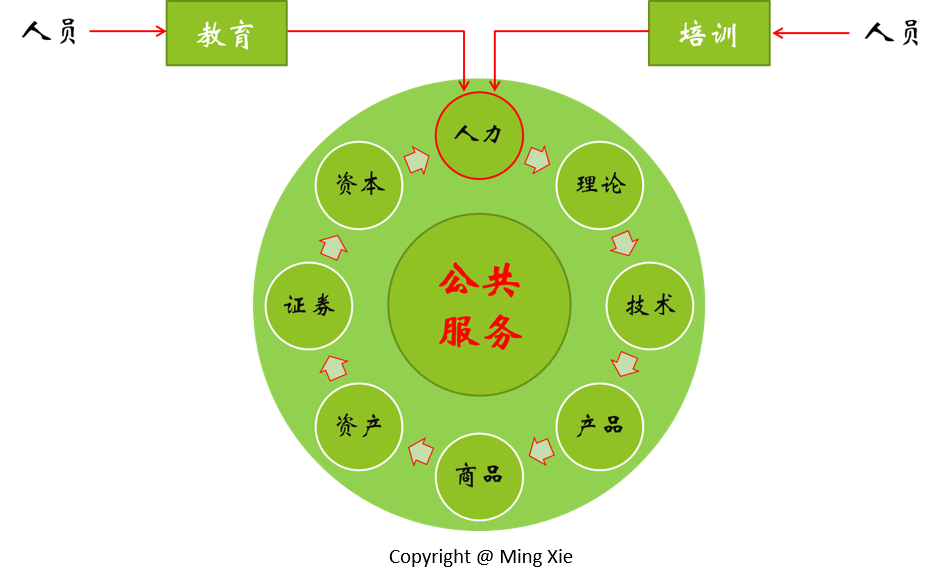
As shown in the figure below, a university is a complex system which includes four major sub-systems such as: the educational system for knowledge transfer (e.g., to undergraduate students), the educational system for knowledge applications (e.g., by postgraduate students), the research system for knowledge creation (e.g., by faculty members and their research assistants (i.e., PhD students)), and the system for product innovation leading to technological joint-ventures and startups.
Experiences of Service
I have had the opportunity to serve as the Dean of the College of Electrical Engineering and Control Science, NanjingTech University, China, between 2014 and 2016. This position has given me the hand-on experiences in reforming the educational systems, research systems and innovation system within the college.
Also, I have jointly launched the International Journal of Humanoid Robotics (www.editorialmanager.com/ijhr) in 2004 and have served as the lead Editor-in-Chief until today. This platform has greatly contributed to today’s advance and achievements of humanoid robots in the world. Obviously. this historical journal has already witnessed its global impact in scientific community as well as in economic field.
In 2010, I have jointly established the national platform of the Robotics Society of Singapore (rss.org.sg). This association is dedicated to promoting robotics in Singapore and beyond. For example, the Robotics Society of Singapore is one of the founding members of the Pacific-Asian Robotics Society Union (https://www.asian-robotics.org/).
Last but not the least, from 2014 until today, I am serving as the technical advisor to the University’s team for the Maritime RobotX Challenges (www.robotx.org) which promote the development of autonomous robots including surface vehicles, drones and underwater robots.
President, Robotics Society of Singapore

Editor-in-Chief, International Journal of Humanoid Robotics
Editor, Special Issue on Bio-Inspired Artificial Intelligence and Autonomous Robots
Robotics and Intelligent Systems: New Mathematical Challenges and Algorithmic Innovations