Talks

Popular Quotes
Powerful Thoughts
Science of Mind as True Foundation of Artificial Intelligence
Does intelligence arise from brain or mind? This is a dilemma of the 21th century. The wrong answer to this question will certainly lead the research efforts into the wrong direction. In this keynote speech, I will share with the audience the astonishing fact which supports the claim that intelligence arises from mind, but not from brain. This truth helps us to open the door toward establishing the Science of Mind which will be the True Foundation of Artificial Intelligence. I will first go through the history of Artificial Intelligence, in which AI 1.0 was primarily focused on machine thinking while AI 2.0 was intensively focused on machine learning. Then, I will outline some extremely important findings about: 1) why AI 1.0 and AI 2.0 are not the foundation of AI, and 2) why AI 3.0, which is a framework toward achieving machine’s self-intelligence, should be the true foundation of AI. More details of our research findings could be found inside the published book: “Xie M., Chen H. and Hu Z. C., (2021), New Foundation of Artificial Intelligence, World Scientific Publishing Co., 404pp”.
.jpg)
(PDF)
KnowNet: A Large Knowledge Model
With the rise of Artificial Intelligence, we are fortunate to witness the transition from achieving machine’s automation to achieving machine’s autonomy. On one hand, the success of Artificial Intelligence is guaranteed by the availability of big data which is the result of the formation of large systems that are interconnected by various networks. On the other hand, the importance of Artificial Intelligence is due to the urgent demand for self-intelligence by robots and machines of tomorrow. Interestingly, the critical step toward achieving machine’s self-intelligence is the ability of designing large knowledge models instead of improving existing databases. In this keynote speech, I will share with the audience our research works which aim at providing a general guiding principle for the design of a large knowledge model under the new paradigm of Artificial Intelligence.
.jpg)
(PDF)
Key Steps Toward Development of Humanoid Robots
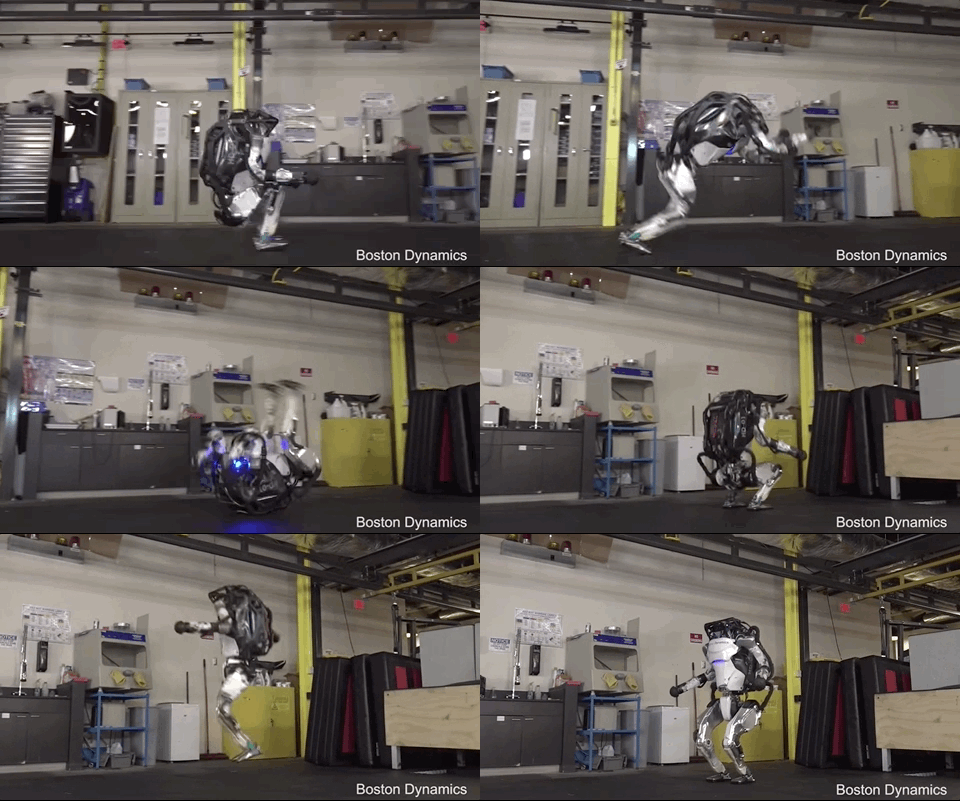
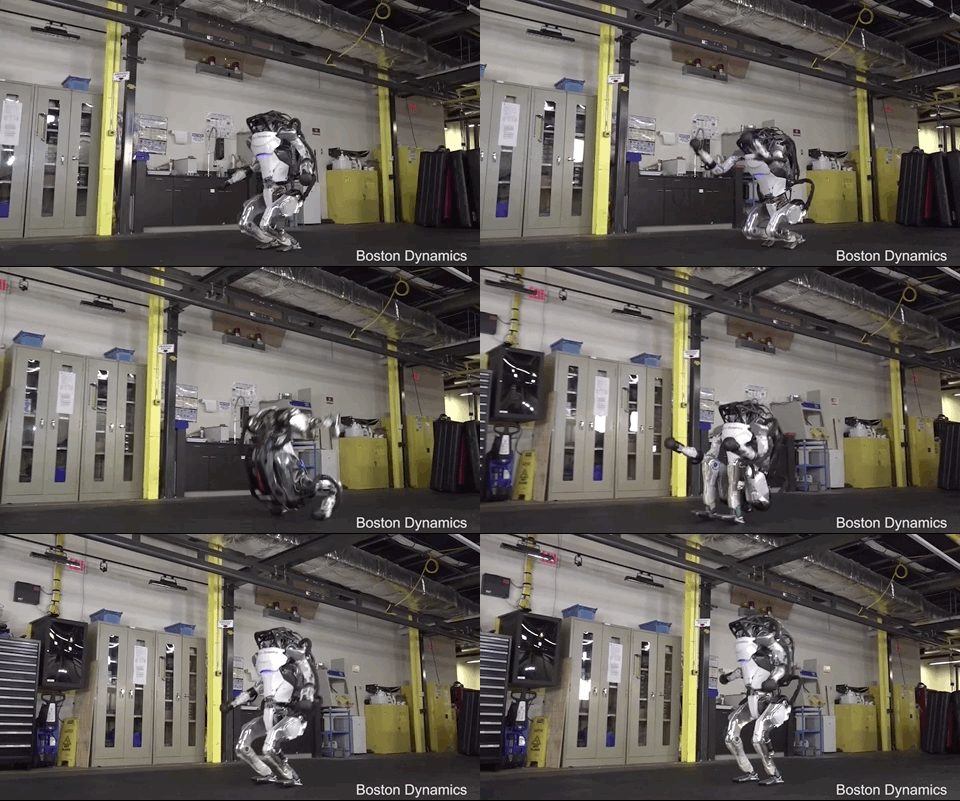
Humanoid robots are biped walking robots which are similar to human beings. As a result, the public has a lot of interests in seeing the advances in the development of humanoid robotics. So far, the most impressive versions of humanoid robots are Honda’s ASIMO, Sony’s QRIO, KAIST’s HUBO, and Boston Dynamics’s Atlas. The new additions to the list include Tesla’s humanoid robots and many others. Therefore, it would be interesting for us to share our experiences gained from the development of Singapore’s humanoid robots since 2008. In this talk, I will adopt a pedagogic way of outlining the key steps toward the development of advanced humanoid robots. Particularly, I will explain the details from the viewpoints of energy flow, signal flow, motion flow, and knowledge flow inside humanoid robots.
.jpg)
(PDF)
Key Technologies for Achieving Autonomous Driving
Future transportations in land, sea and air will depend on the massive deployment of autonomous vehicles. In this way, the traffic safety could be guaranteed by advanced technologies. In addition, the autonomies to be achieved by future vehicles in mobility will largely help us to reduce the dependence on the employment of skilled human drivers. In this way, we are ready to tackle the problem caused by the shortage of well-trained manpower in the sectors of transportations. In this keynote speech, I will present the key technologies behind the achievements of autonomous driving by all kinds of vehicles in land, sea and air. The autonomous driving scenarios of these vehicles include landmark following, target identification and following, automatic parking/docking, collision avoidance, automatic landing, and automatic manoeuvres, etc.
.jpg)
(PDF)
.jpg)
(PDF)
.jpg)
(PDF)
.jpg)
(PDF)